

This past month, I received a call from a gentleman who was rebuilding an N14 mechanical engine that originally had aluminum pistons. He was installing steel top pistons from a 525-hp CPL 2025. Whenever compression ratio pistons are changed, the timing, injector spray angle, and in some cases the camshaft and turbine housing, must all be matched properly.
I hadn’t supplied him with any of the parts, but I always try to help owner operators when I can. I explained that the timing on his original engine was .172, while the pistons he was installing required .352 – a significant difference. He wasn’t planning to change the camshaft or adjust the injection timing. Because of budget concerns, his plan was simply to replace the pistons.
Two years earlier, we had reflowed the injectors and fuel pump for his engine. This recent conversation took place in the evening, after the shop was closed, so I didn’t have access to the exact injector spray angles or compression ratio specifications. I advised him three different times to call the shop where he had purchased the parts and confirm both the piston compression ratios and the injector spray angles. It is critical that the spray angle matches the piston bowl.
Unfortunately, he chose to move forward, without verifying those details. Two days later, while hauling a load south, his engine scored the #6 liner after just 36 miles. He called me back, concerned that the injectors we had reflowed two years earlier were to blame. However, injectors on a Big Cam or N14 mechanical engine cannot overflow and wipe out a liner, so that could not have been the cause.
To make sure nothing was overlooked, I spoke with Brian, our shop foreman, who has 38 years of experience at Pittsburgh Power. He explained that we routinely install steel top pistons in mechanical N14s, but it is essential to change the injector cups. The mechanical N14 injector cup has a 17-degree spray angle, whereas the electronic version, with steel top pistons, requires a 14-degree angle. Three degrees may not sound like a lot, but it’s enough to keep the spray from properly reaching the piston bowl. In this case, that mismatch led to the liner being damaged in just 36 miles.
The takeaway from this is that all components must be matched when changing piston designs. Even small differences can have major consequences. Our goal at Pittsburgh Power is to guide operators to solutions that protect their investment, extend engine life, and prevent costly downtime. By consulting with our experienced team and using the correct components, problems like this can be avoided.
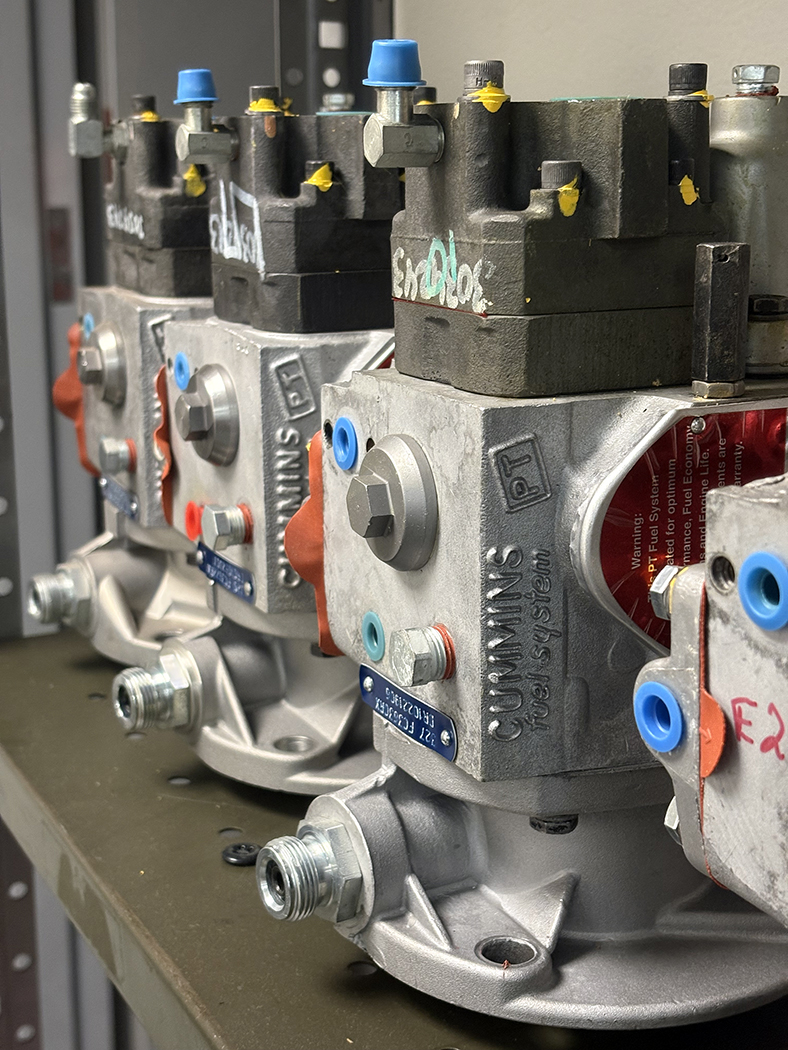
Pat Sharp, our pump, injector, and turbocharger rebuilder, has been with Pittsburgh Power for almost 41 years and is without a doubt the best builder in the world. Every week I get phone calls from owner operators and farmers who tell me they have a Big Cam Cummins, just had the pump and injectors rebuilt locally, and yet the engine is still low on power, smokes, lacks responsiveness, and sometimes even has a miss. My next question is always the same: who built the pump and injectors? The answer is usually, “Some local guy.” From there, the questions start piling up. What lubricant was used on the O-ring? Where was the fuel inlet screen faced? How were the injector tubes cleaned? How were the injectors torqued down, and what type of torque wrench was used? Was the fuel restriction coming into the pump checked? How old are the suction and fuel return lines? What is the code on the fuel pump? What is the fuel pressure? What is the top RPM? Do you have our dual fuel line kit installed on the engine? And finally, was the fuel return line removed to see if the engine would decelerate when the throttle was released? This is the process Brian goes through nearly every week when he gets these calls.
There is something else to keep in mind – these older engines, especially those from 2002 and earlier, were not designed to run on today’s ultra-low sulfur diesel fuel. This applies to all diesel engines. Before you spend time and money chasing what you think is an engine problem, consider that it may simply be the fuel. The best solution is to treat the fuel with Max Mileage Fuel Borne Catalyst and Flash Point to restore the quality to where it should be for these engines. If the engine is also consuming oil, run these two products for at least 90 days, and you may notice a reduction in oil consumption. Max Mileage burns 70% more of the carbon and soot in the combustion chamber and will clean the carbon out of the piston’s ring gland.
Returning to rebuilding fuel pumps and injectors, the easiest path is to call Brian here at Pittsburgh Power at (724) 360-4080, explain the problem, and perform the tests he recommends. If the issue remains, send the pump and injectors to Pittsburgh Power and let Pat Sharp, the true expert, make them perfect for you. We specialize in rebuilding Cummins Small Cam, Big Cam, KTA-19 and VT-903 fuel pumps and injectors. To see all our products and services, visit us at our shop in Saxonburg, PA or go online 24/7 at www.pittsburghpower.com.