


A 2002 Peterbilt 379 day cab was recently brought to us with a vibration complaint. This 379 had a Caterpillar C12 engine and 13-speed Eaton transmission and is operated at a local landscape company. The customer stated they can feel the vibration in all gears and speeds. This typically means the vibration isn’t coming from the driveline, transmission, rear ends, or wheel ends. Our vibration analyzer sees all the vibrations simultaneously, so we proceeded with the test. I could tell right away that something was wrong with the engine. The entire cab rattled and would have failed the old Lexus trick of stacking wine glasses on the hood as seen in that 1989 ad.
I could see on our vibration analyzer a big spike at 35 Hz. This spike was 105-110% more than the highest vibration permitted at that frequency. There is actually a specification for maximum vibrations in your truck. I guess they have a specification for everything these days. The vibration of 35 Hz at engine idle indicates that this is a 3rd order vibration. 3rd order means a vibration occurs three times for every engine rotation. So, what do you think might be happening three times for every one rotation of the crankshaft? Combustion!
An inline six engine has a firing order of 1-5-3-6-2-4 and is phased 120 degrees apart. This means a cylinder fires, then 120 degrees of crankshaft rotation later, the next cylinder fires, and then 120 degrees later, another cylinder fires, etc. One rotation is 360 degrees. If you were to split that 360 three ways evenly, you get 120 degrees. This even firing is what makes inline engines so smooth. So, normal combustion means there are three bangs for every rotation, hence a 3rd order vibration. This vibration on the analyzer is normal and will always be there while the engine is running. However, since there is a specification, we can see that the vibration on this Caterpillar was much higher than it should be.
An abnormal 3rd order vibration can suggest a few things that might be wrong. A failed crankshaft damper (replace yours every 500K miles), a bent crankshaft, some unbalance in the flywheel or clutch assembly, or abnormal combustion. Some of these options are more probable than others. We found that the customer had already replaced the crankshaft damper in an attempt to fix the issue. We then inspected the clutch through the inspection panel, and it looked fine, albeit you cannot see very much while everything is together. The next most straightforward test is a humble cylinder cutout test through diagnostic software. While the engine idles, we manually turn off and on every cylinder. If everything is working correctly, you can hear a significant difference in the tone of the engine.
When we did this test, we heard no change on cylinder 5. Something was wrong with that cylinder. The ECM never threw a check engine light for this, and many people felt this vibration at idle was normal. They would say, “It’s a Cat, of course they shake.” This is the completely wrong answer and comes from people who don’t have knowledge about how an engine should feel. This special touch comes from years of experience and why you should be careful where you take your truck. The solution for this vibration was simple – it was a failed injector. Once we replaced the injector, the vibration dropped by 130%! This was the first of many successful vibration analyses.
Is your turbocharger throwing oil out the compressor side or fresh air side? This does not mean the turbocharger needs to be replaced or rebuilt. The seals in turbochargers are small piston rings and their purpose is to contain the oil in the bearing housing. The three reasons the oil is leaking into the compressor housing is the air filter is wet, dirty, or too small. Also, if the blow-by tube is clogged, being pinched off at highway speeds, or if there is a filter in the system and it’s clogged, the blow-by will try to go up the turbo drain tube, thus forcing the oil out the compressor side.
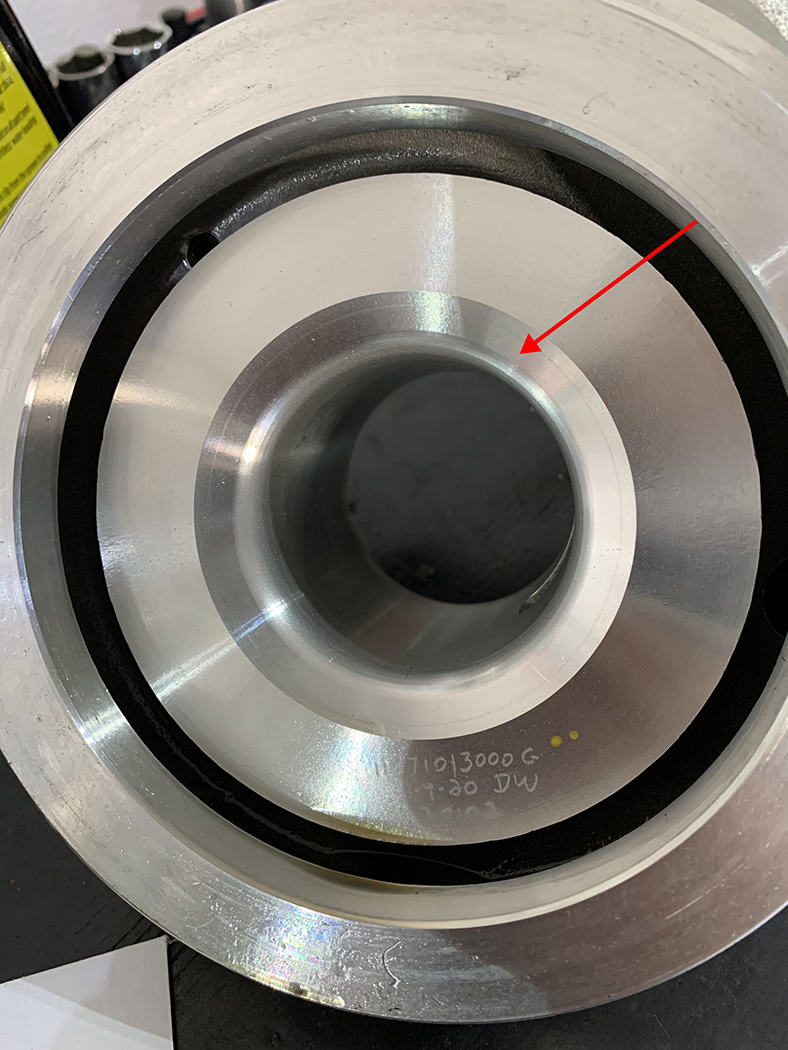
To fix the problem, replace the air filter or clean the blow-by tube. Remove the pipe from the turbocharger to the charge air cooler and clean out the oil (you should remove the compressor housing and clean it, too). While the housing is off, polish the volute, the curved part that fits against the compressor wheel (see red arrow in the photograph), and the turbocharger will produce 2 to 3 pounds more boost, thus lowering the exhaust gas temperature by 50 to 75 degrees, plus the turbocharger will accelerate quicker. This should be cleaned and polished once a year, especially in the springtime. Now, put the turbocharger back together, along with the piping. Drive the truck for 100 miles and then remove one of the hoses. There should be no signs of excessive oil. A slight trace of oil is okay because it helps to lubricant the upper valve stem.
If you would like us to make a video of this procedure and have it posted on our website, please call Jordan at Pittsburgh Power (724) 360-4080 and let him know. And thanks to Leroy Pershing for helping out with the vibration analysis portion of this text. Stop by our shop in Saxonburg, PA during normal business hours, or visit our website at www.pittsburghpower.com anytime!