


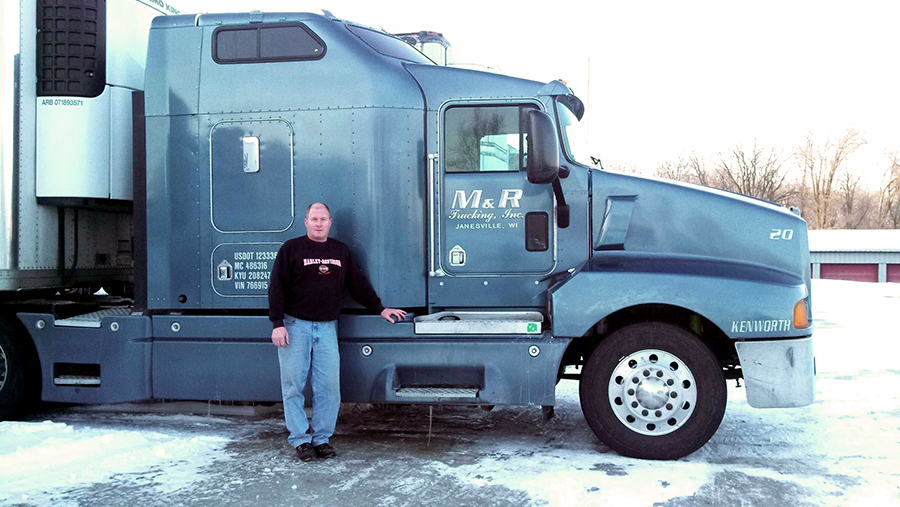
 This month we are going to talk about an old favorite subject of mine and something I brought to the trucking industry some 38 years ago – driving by the turbo boost gauge. One of the best owner operators at doing this is DuWayne Ehrke, the owner of a 1998 T600 Kenworth powered by a Pittsburgh Power DD4 Detroit. His truck features 2:64 rear gears and a 13-speed double-over transmission, and his engine is pushing 740 hp.
DuWayne and I spent many hours together recently at Kevin Rutherford’s conference in Kansas City, discussing fuel mileage and turbo boost. Today, as I write this, DuWayne is driving in high winds coming out of the northwest, heading north in Kansas, grossing 79,700 pounds. Driving in his usual 11th gear, which is direct, at his usual 64 mph, he works to keep the tachometer around 1,400 rpm (at 12 pounds of turbo boost he gets 5.3 mpg).
Now, this is something I want to you think about – when the wind is not blowing, DuWayne can keep the boost as low as 4 psi, which gives him 10 mpg (since not everything is level, this is not possible for the entire trip). At 10 psi, DuWayne’s truck gets 5.5 mpg, a 48% drop in fuel mileage, when only using 4 psi of boost. As you can see, turbo boost equates to power being used, and on the level, you need to try and get the boost as low as possible.
Cruise control will kill fuel mileage, especially on hills, in heavy-haul situations, and in the wind, but don’t try to keep the boost gauge at a low number all of the time – sometimes you need the power! To go up a hill or mountain, you must use turbo boost or power (it’s okay to spend, but you must make the most of what you’re spending), so please do not try to stay at 10 psi on the hills, because you will just be in the way of other motorists. What we are talking about here is the development of your professional driving skills – “steering wheel holders” can stop reading now. Use power to get over the hill and on the downside or level try various gears and speeds to lower the turbo boost for fuel mileage. Now, back to the high-side winds on DuWayne’s rig today in Kansas.
Instead of running in direct gear (11th), he had to run half a gear lower (10th) to raise the rpm to 1,550 and lower the turbo boost to 7 psi in order to salvage some fuel mileage for this trip. Although these are pro maneuvers, with some time and practice, you too will get these tactics down, and really become a skilled driver. At 7 psi, the fuel mileage is 7.75 mpg. I have been saying for years that higher rpm’s do not use more fuel, as long as your foot is not planted in the throttle! So, by raising the rpm, the engine was no longer struggling to pull against the wind.
Keep this in mind – the 12.7 Detroit is a smaller engine than the 15-liter Cat and has a shorter stroke, thus developing less torque-per-stroke. In regards to small block versus big block, small blocks need a little more rpm, whether gasoline or diesel, to produce the same amount of power as a big block.
As I was on the phone with DuWayne, I asked him to put the transmission back into 11th gear and hold the throttle at 1,300 rpm and the results were: 58 mph, 12.5 pounds of turbo boost, and the Kevin Rutherford Scan Gauge showed 4.8 to 5.1 mpg. Plus, the engine did not like the lower rpm – it was struggling to maintain the 1,300 rpm, and because of this, the exhaust gas temperature raised to 1,050 degrees (as opposed to 850 degrees when the tachometer was at 1,550 rpm).
An engine is an air pump – as the rpm goes up, more air passes through the engine, causing the exhaust gas temperature (EGT) to drop. The more air, the lower the EGT. The thermocouple is on the hot side, before the turbocharger. If the thermocouple is in the exhaust pipe, there is a 300 degree drop in temperature. We prefer to have the thermocouple in the exhaust manifold for a more accurate reading (many early models of our power boxes were programmed to read from the manifold and not from after the turbo, for this very reason). What I want you to get from all this is that you must have a free-running truck to be able to select the proper gear for the load, terrain and weather conditions, and use the turbo boost and EGT gauge, along with the Kevin Rutherford Scan Gauge, to obtain the best fuel mileage for that trip.
As of 6:30 p.m. on this particular day, DuWayne was in Iowa, still heading north, and the wind had died down. Because of this, he was back in 11th gear and running 64 mph at 1,420 rpm, and using 2 to 6 psi of turbo boost. Rain, snow, and especially slush, will require a lower gear and more attention to the gauges. Leave the cruise control off if you want to obtain the best fuel mileage the truck can deliver, and pay attention to your gauges. Use power on the hills, be cool on the level, and enjoy your ride. For those of you who cannot grasp these concepts, don’t even bother aspiring to get 8+ mpg – it just won’t happen.
One last point I’d like to make this month is about lugging your engine. As you are driving, if you ease into the throttle and the speed does not increase, you are lugging your engine, producing more EGT, and using more fuel. According to the engineers at Detroit Diesel, the 12.7-liter engine should not be operated below 1,400 rpm (unless the load is light and the terrain is mostly downhill, then you can run at a slightly lower rpm). Now, you can see why I do not like a 10-speed. A 13- or 18-speed transmission, that gives you the ability to split the gears, will allow you, the operator, to be at the best rpm, for that load and terrain, all of the time.
You, the best drivers out there, are a dying breed, and you probably already know this. However, sometimes, it’s worth trying to pass down our hard-earned knowledge. I hope you take it to heart and become a better driver, because we will all benefit from that! If you have any comments or questions, I can reached at Pittsburgh Power, Inc. in Saxonburg, PA at (724) 360-4080 or via e-mail at bruce1@pittsburghpower.com.
1 Comment
I’ve been researching for 2yrs NIW on the most efficient pre-emissions truck. I lease a 2018 cascadia right now but took the plunge and bought a 2000 t600 12.7 Detroit. I did this because all the research pointed to this exact truck! It’s a 430/500 2100 rpm motor that just happens to be built in 1999. No elog. Will also help me make more money! Talked with Bruce o the phone and was reassured that I bought the right truck! I will let you know once it’s going down the road.